
NSX-T: Retrieving Logs via the API
Learn how to get NSX node logs using the dedicated API.
NSX is a Software-Defined Networking (SDN) solution provided by VMware. OVHcloud is offering this service in place of NSX-V in its VMware on OVHcloud solution.
At the moment (November 1, 2023), due to the implementation by OVHcloud, it is not possible to export the logs of an NSX-T via a syslog server. To remedy this, you can retrieve a few logs via API calls.
Requirements
For the current version of NSX to work, two hosts are deployed with a dedicated virtual machine for NSX on each host, allowing redundancy in the event of one of the hosts failing.
Moreover, the following prerequisites are required:
- NSX hosts are deployed.
- A user with NSX access rights.
- You need to verify that the node is enabled.
Instructions
Gather logs with the API
Before logs can be retrieved, you will need to enable the logging option on the corresponding rule.
NOTE: By default, logs are not enabled on rules!
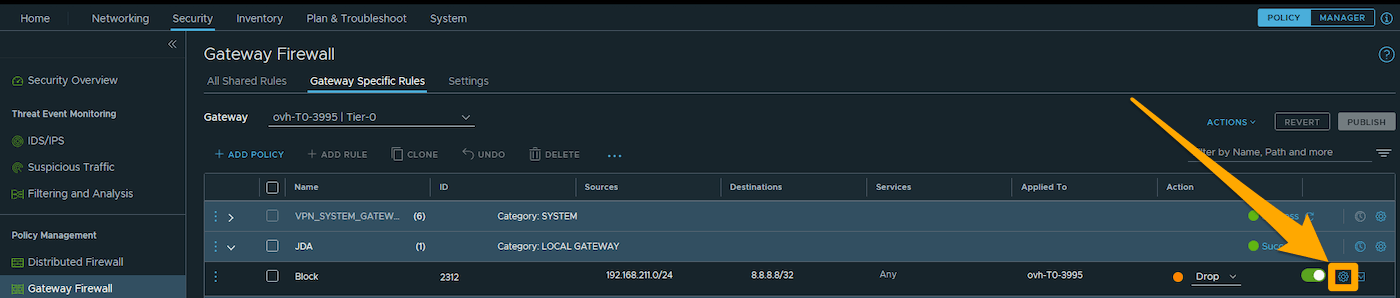
For example, consider a rule that blocks all IP addresses between 192.168.211.0/24 and 8.8.8.8/32.
To access the configuration of a rule, click the settings button (in the form of a cogwheel) to the right of the rule you have chosen.
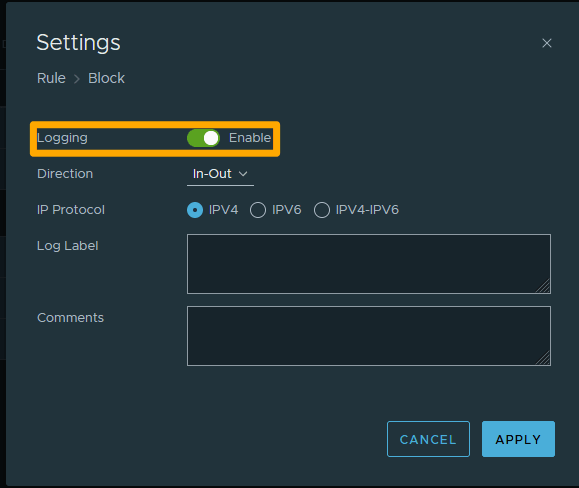
The rule settings are then available. Enable the logging option that should switch to green.
Make sure to apply the new configuration and publish it.
Gather the logs
To have access to the logs, you must identify the Edge NSX ID. To do this, use this first API call:
🔽 Example response:
This API call returns the two IDs of your two Edge nodes:
Once you have retrieved the ID of your Edge node, make an API call to get the logs for your rule:
🔽 Example response:
The call then returns the logs associated with your rule:
Retrieving logs with bundle
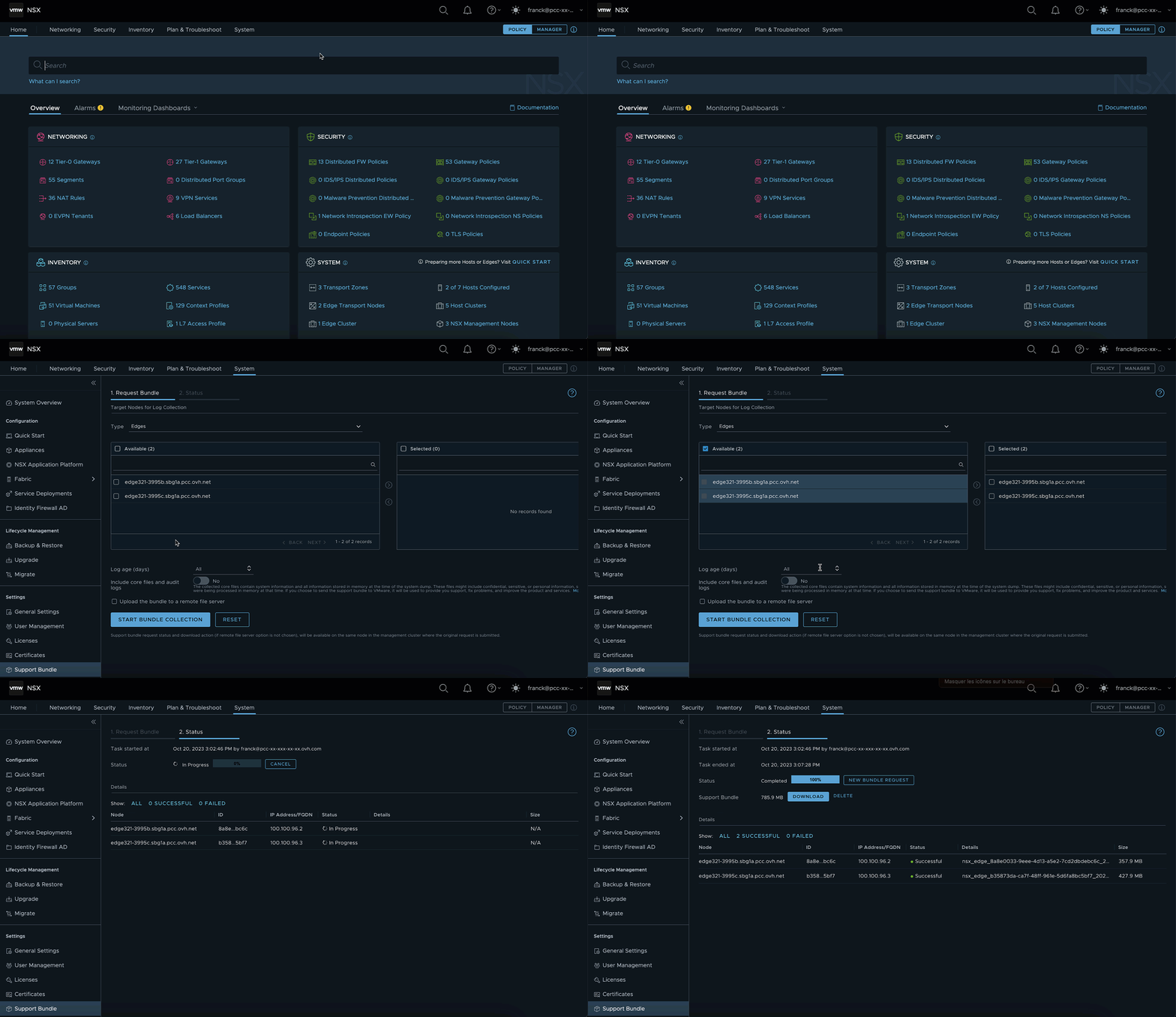
To download the bundle support for your nodes or cluster to your file server/machine, follow the official VMware documentation.
Go further
NSX-T Datacenter Rest API documentation
Browse all the VMware on OVHcloud guides.
Browse the rest of the OVHcloud US documentation for guides on our other products and services.
Learn more about VMware on OVHcloud on the OVHcloud US website.