
Creating a volume from a backup
You can attach additional disks to your Public Cloud instances based on previously created volume snapshots. This may be useful in the following cases:
- If you want to restore additional disk data.
- If you want to have a highly available, high-performance storage space for your data.
- If you want to move your data to another instance.
Requirements
- A Public Cloud instance in your OVHcloud account
- A volume snapshot in the same OpenStack region
- Administrative access (root) to your instance via SSH or RDP
OVHcloud Control Panel Access
- Direct link: Public Cloud Projects
- Navigation path:
Public Cloud> Select your project
Instructions
Creating the disk from a backup
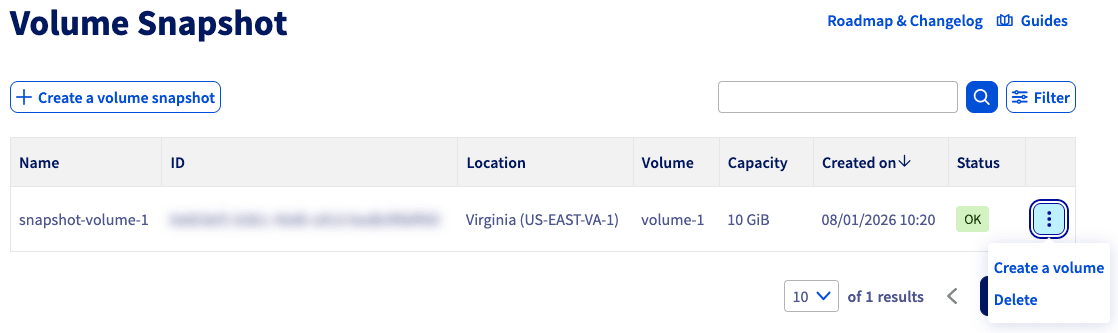
In the left-hand menu, under Storage, click Volume Snapshot.
In the row of the volume concerned, click the more options ... button and select Create a volume.
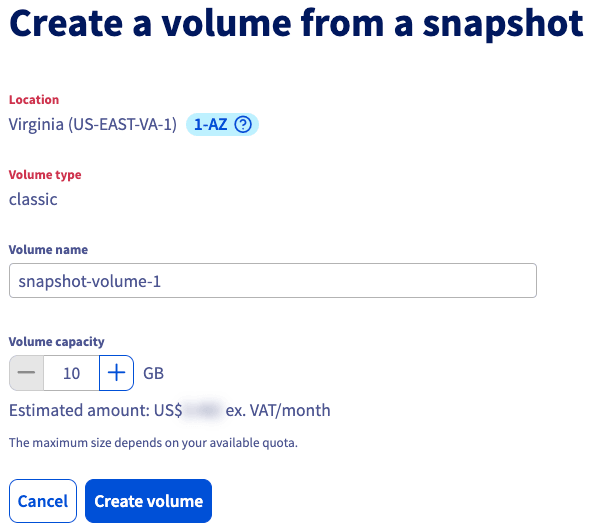
Change the default name and volume capacity if you want, and click Create the volume.
It may take a few minutes to create the disk, depending on its size.
Attaching the disk to an instance
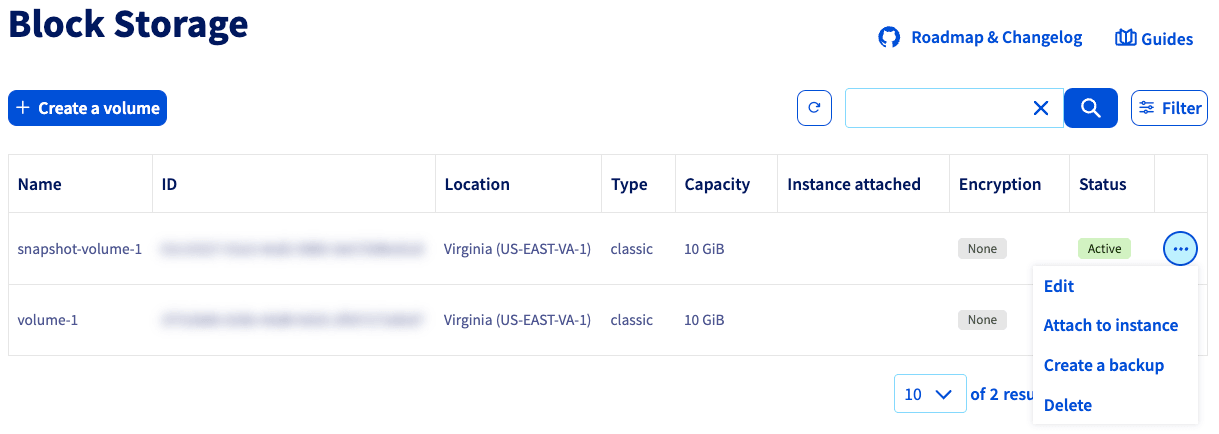
Once the disk has been created, you will be redirected to the Block Storage area.
In the row of the volume concerned, click the more options ... button and select Attach to instance.
In the pop-up window, select an instance and click Confirm to attach the disk to it.
Attaching the disk to your instance will begin, which may take a few minutes.
NOTE: Make sure not to leave the current page in your OVHcloud Control Panel while the disk is being attached. This may interrupt the process.
Once the attachment is complete, you can follow these steps to configure the disk using Linux or Windows.
Go further
Browse all the Block Storage guides.
Browse the rest of the OVHcloud US documentation for guides on our other products and services.
Learn more about Block Storage on the OVHcloud US website.