
Getting started with Object Storage
If you are using legacy Swift Object Storage, follow this guide.
For new projects, we highly recommend using our S3™*-compatible Object Storage, which benefits from our latest innovations and new features.
Requirements
- A Public Cloud project in your OVHcloud account
- An Object Storage user already created
OVHcloud Control Panel Access
- Direct link: Public Cloud Projects
- Navigation path:
Public Cloud> Select your project
Instructions
If you wish to use the OVHcloud Terraform provider, see our Manage an Object Storage bucket with Terraform guide.
Preparation
To use the AWS CLI
To find out how to install the AWS CLI in your environment, we recommend you read the official AWS documentation.
Check installation
If you need more information about AWS CLI installation, read the AWS documentation.
Collect Credentials
- Retrieve your user's Access key and Secret key. You can retrieve this information from the OVHcloud Control Panel under
Public Cloud>Object Storage>Users. - You will also need your endpoint_url and the region. If you have already created your container, find this information in the
My containerstab in the details of your container. If needed, see our Object Storage - Endpoints and geoavailability guide.
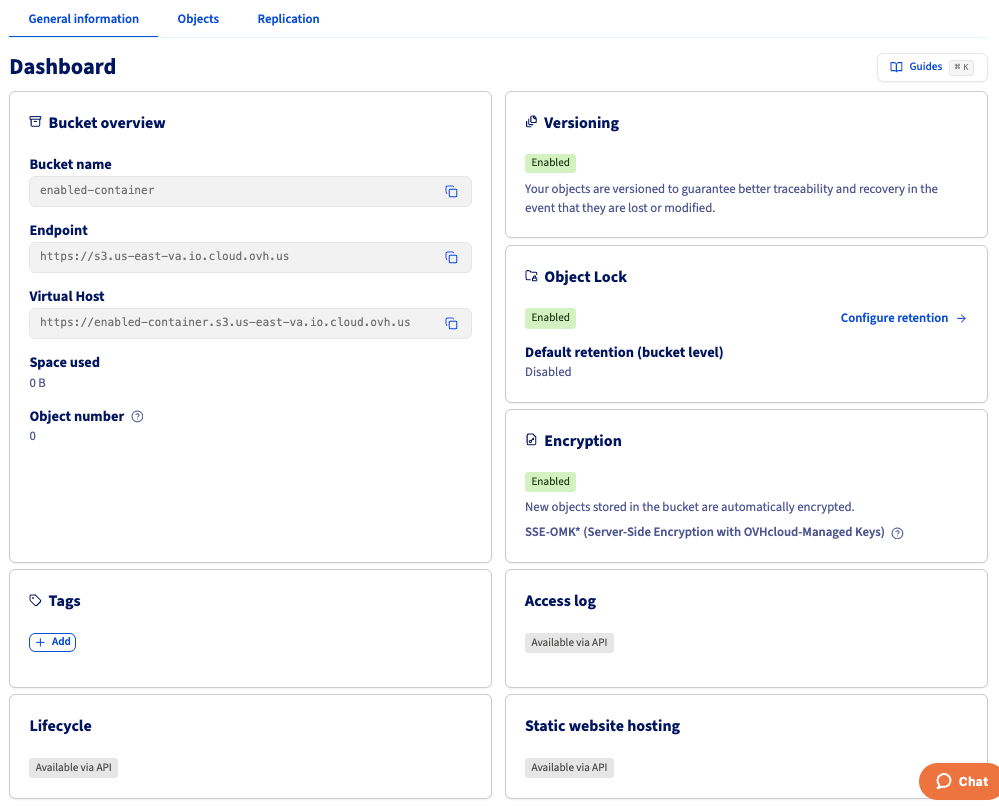
Where to find the Endpoint URL of a container
Click the name of the container and then the General information tab.
Configuration
Use the interactive configuration to generate the configuration files, or create them manually.
To use the interactive configuration, run the following command: aws --configure or aws configure --profile <profile_name>
The configuration file format in the AWS client is as follows:
Here are the configuration values you can set:
For a list of endpoints by region and storage class, see the Object Storage - Endpoints and geoavailability guide.
Usage
If you have more than one profile, add --profile <profile_name> to the command line.
Using the OVHcloud Control Panel
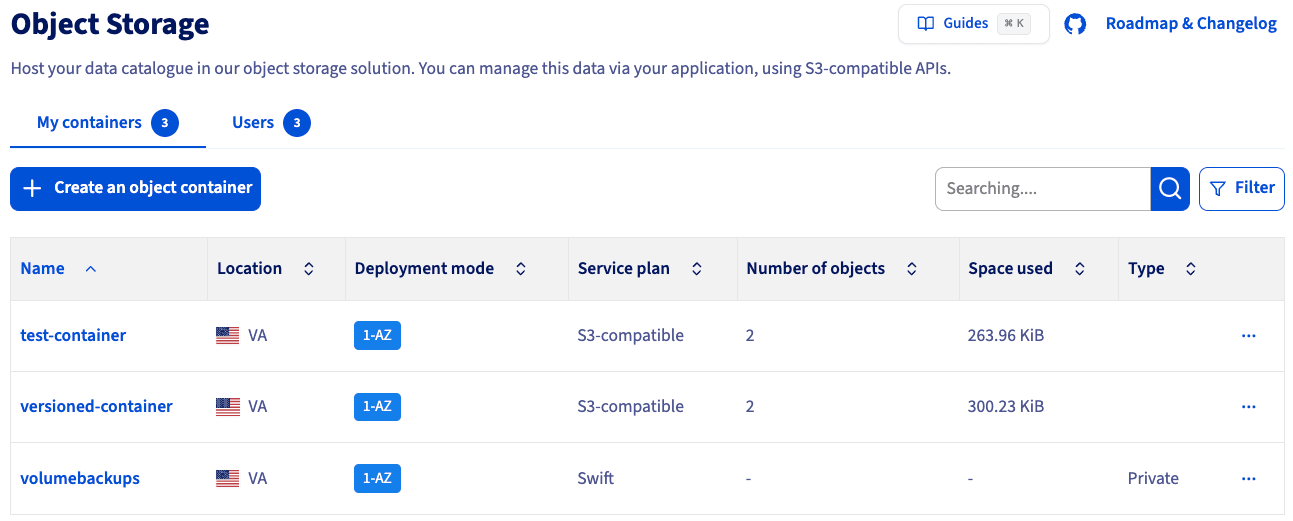
To manage an Object Storage bucket, navigate to Object Storage in the left-hand menu.
Listing your buckets
Via AWS s3
Via AWS S3API
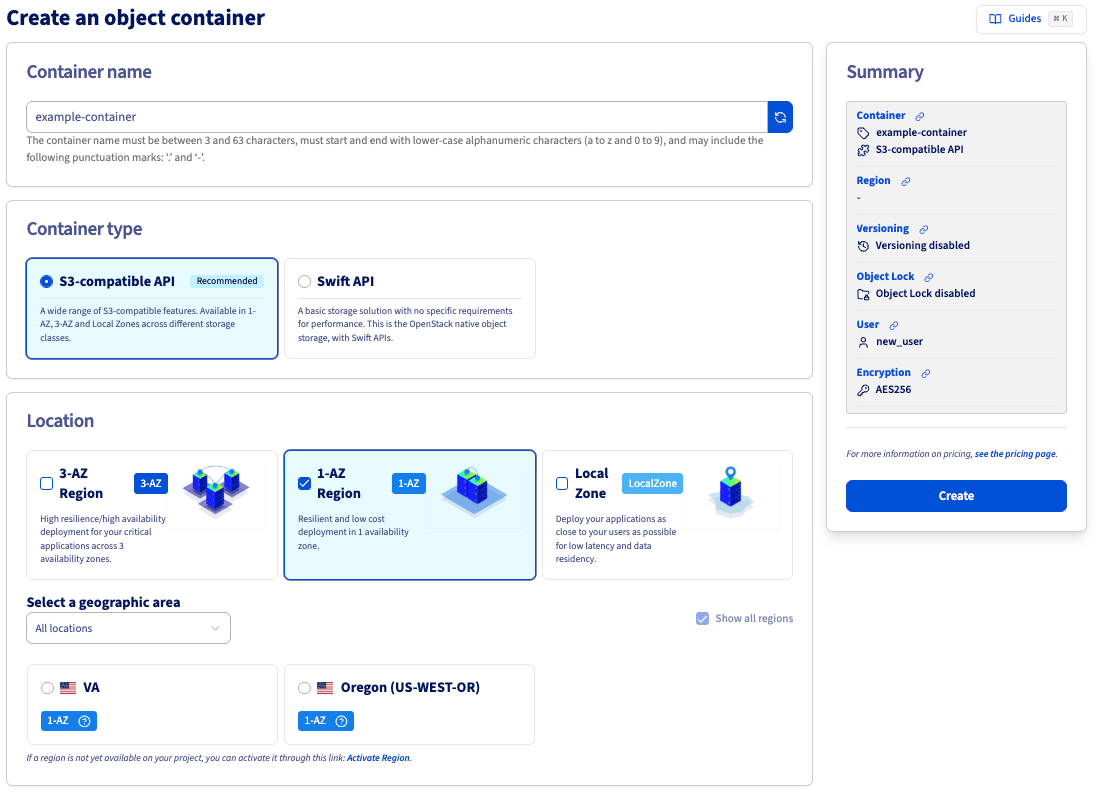
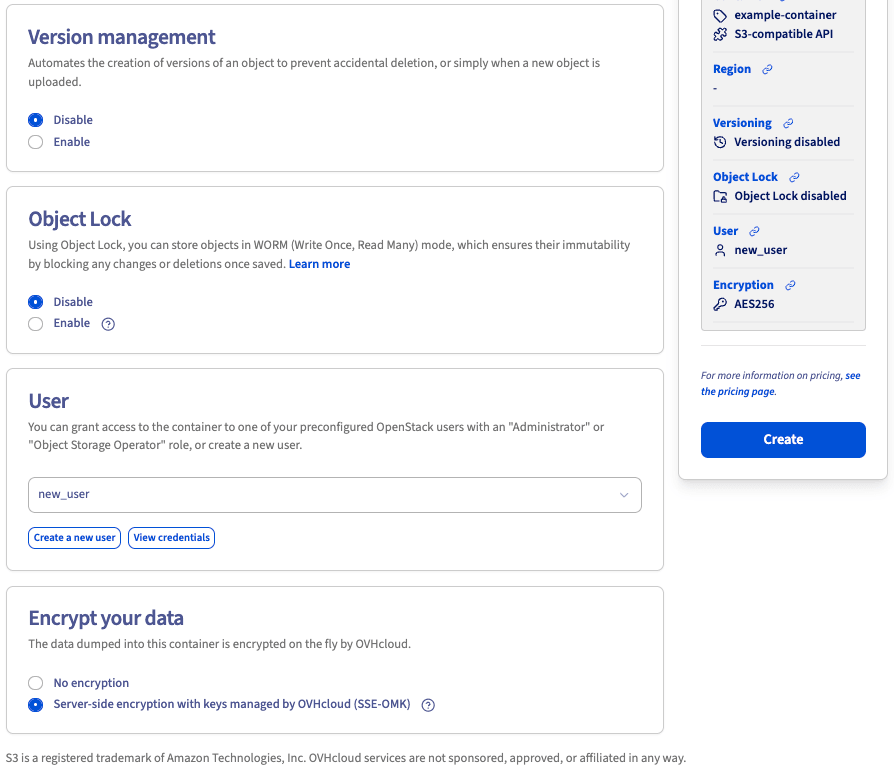
Create a bucket
Via AWS s3
Via AWS S3API
Uploading your files as objects in your bucket
When uploading objects, select a storage class to control availability, redundancy, and cost. To help you choose the right storage class for your needs, see the Choosing the right storage class for your needs guide.
The aws s3 cp command will use STANDARD as default storage class for uploading objects. To store objects in the High Performance tier, use the aws s3api put-object command instead, as aws s3 cp does not support the EXPRESS_ONEZONE storage class, which is used to map the High Performance storage tier. To learn more about the storage class mapping between OVHcloud storage tiers and AWS storage classes, you can check our documentation here.
Via AWS s3
To upload an object:
By default, objects are named after files, but can be renamed:
Downloading an object from a bucket
Via AWS s3
Downloading an object from a bucket:
Uploading an object from one bucket to another bucket:
Downloading or uploading an entire bucket to the host/bucket:
Via AWS S3API
Downloading an object from a bucket:
Uploading an object from one bucket to another bucket:
Synchronizing buckets
Via AWS CLI
Deleting objects and buckets
A bucket can only be deleted if it is empty.
If your bucket has Object Lock enabled, you will not be able to permanently delete your objects. See our documentation to learn more about Object Lock. If you use Object Lock in GOVERNANCE mode and have the permission to bypass GOVERNANCE mode, you will have to add the --bypass-governance-retention option to your delete commands.
Via AWS s3
To delete an object:
To remove all objects from a bucket:
To delete a bucket, it must be empty:
If the bucket is not removed, you can use the same command with the --force option. This deletes all objects from the bucket, and then deletes the bucket.
Deleting objects and buckets with versioning enabled:
If versioning is enabled, a standard delete operation on your objects will not permanently remove them.
To permanently delete an object, you must specify a version ID:
To list all objects and their version IDs, you can use the following command:
With the above delete-object command, you will have to iterate over all your object versions. You can also use the following one-liner to empty your bucket:
Via AWS S3API
Deleting objects and buckets:
Deleting objects and buckets with versioning enabled:
If versioning is enabled, a standard delete operation on your objects will not permanently delete them.
To permanently delete an object, you need to specify a version identifier:
Manage tags
Via AWS S3API
Setting tags on a bucket:
Deleting tags on a bucket:
Setting tags on an object:
Deleting tags on an object:
Go further
Browse all the Object Storage (S3™-compatible) guides.
Browse the rest of the OVHcloud US documentation for guides on our other products and services.
Learn more about Object Storage on the OVHcloud US website.
*S3 is a trademark filed by Amazon Technologies, Inc. OVHcloud's service is not sponsored by, endorsed by, or otherwise affiliated with Amazon Technologies, Inc.